On 12 November 2007, representatives of the
Russian Federal Space Agency (Roscosmos) and ISRO signed an agreement for the two agencies to work together on the Chandrayaan-2 project.
] ISRO would have the prime responsibility for the orbiter and rover, while Roscosmos was to provide the lander. The
Indian government approved the mission in a meeting of the
Union Cabinet, held on 18 September 2008 and chaired by
Prime Minister Manmohan Singh.The design of the spacecraft was completed in August 2009, with scientists of both countries conducting a joint review.
Chandrayaan-2 launch was initially scheduled for 14 July 2019, 21:21 UTC (15 July 2019 at 02:51 IST local time), with the landing expected on 6 September 2019
] However, the launch was aborted due to a technical glitch and was rescheduled.The launch occurred on 22 July 2019 at 09:13 UTC (14:43 IST) on the first operational flight of a GSLV MK III M1.

Chandrayaan-2 orbiter at integration facility
As of September 2019, the Chandrayaan-2
orbiter was orbiting the Moon on a polar orbit at an altitude of 100 km (62 mi).It carries eight scientific instruments; two of which are improved versions of those flown on
Chandrayaan-1. The approximate launch mass was 2,379 kg (5,245 lb). The Orbiter High Resolution Camera (OHRC) conducted high-resolution observations of the landing site prior to separation of the lander from the orbiter.The orbiter's structure was manufactured by
Hindustan Aeronautics Limited and delivered to
ISRO Satellite Centre on 22 June 2015.
Vikram landerEdit
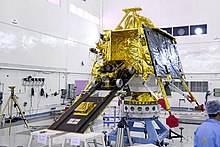
Rover Pragyan mounted on the ramp of Vikram lander
The
Vikram lander detached from the orbiter and descended to a low lunar orbit of 30 km × 100 km (19 mi × 62 mi) using its 800 N (180 lb
f) liquid main engines. It then performed a comprehensive check of all its on-board systems before attempting a
soft landing that would have deployed the rover, and perform scientific activities for approximately 14 Earth days.
Vikram spacecraft apparently
crash-landed The approximate combined mass of the lander and rover is 1,471 kg (3,243 lb).
Pragyan roverEdit

Pragyan rover of the Chandrayaan-2 mission
The mission's rover is called
Pragyan (
Sanskrit:
प्रज्ञान,
lit. 'Wisdom')
 Pronunciation (help·info)
)with a mass of 27 kg (60 lb), would have operated on
solar power.The rover was to move on 6 wheels traversing 500 meters on the lunar surface at the rate of 1 cm per second, perform on-site analyses and send the data to the lander, which would have relayed it to the Mission Control on the Earth.For navigation, the rover uses:
- Power: 50 W
- Travel speed: 1 cm/sec.
- Mission duration: ≤14 days (one lunar day)

Mission overview
ISRO selected eight scientific instruments for the orbiter, four for the lander,and two for the rover.While it was initially reported that
NASA and
ESA would participate in the mission by providing some scientific instruments for the orbiter, ISRO in 2010 had clarified that due to weight restrictions it will not be carrying foreign payloads on this mission.However, in an update just a month before launch,an agreement between NASA and ISRO was signed to include a small laser
retroreflector from NASA to the lander's payload to measure the distance between the satellites above and the microreflector on the lunar surface.
Pragyan roverEdit
Pragyan rover carries two instruments to determine the abundance of elements near the landing site:
Laser retroreflector array (LRA)


_Wellcome_L0035004_20180530183412.jpg)
_20180530181930.jpg)


_around_Moon.gif)

_at_ISTRAC,_Peenya_before_commencement_of_fourth_orbit_raising_burn_for_Chandrayaan-2.jpg)


_Wellcome_L0035004.jpg)
